Do you enjoy speaking?
How about swallowing?
What about breathing?
All great things, to be sure.
And you have your larynx to thank for all of them.
Issues with your larynx can result in speech disorders that affect your ability to produce speech.
Today, we’re going to be taking a closer look at what the larynx is, how it functions, what speech disorders are associated with it, and how a speech therapist can help.
What Is Your Larynx?
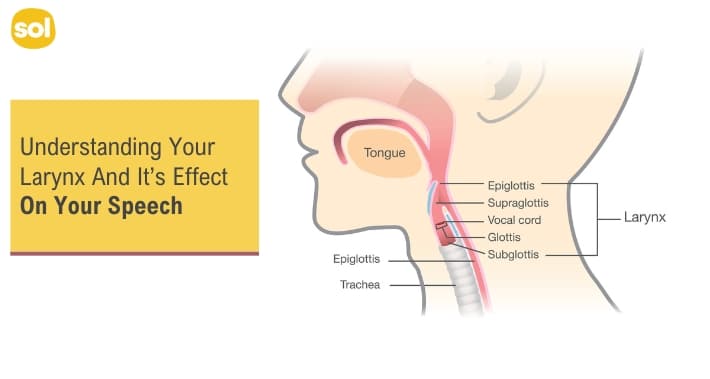
Your larynx, also known as your voice box, is the main part of the vibratory system of your voice mechanism.
It’s a hollow tube, about four to five centimeters in length.
Your larynx is located in your neck, above your trachea and esophagus.
The main function of the larynx is to open and close the glottis, an opening that’s located between your two vocal folds.
The larynx is responsible for helping you breathe.
When you breathe air in, your larynx funnels it down to your trachea and into your lungs.
Additionally, your larynx acts like a barrier, protecting your respiratory system by preventing food from going into your trachea while you breathe.
The reason why your larynx is also called your voice box is because it contains your vocal folds.
Your vocal folds allow you to produce sound and create speech.
The Parts Of Your Larynx
There are three different parts that make up your larynx.
They are the:
- Supraglottis
- Glottis
- Subglottis
The glottis plays a key role in breathing, your cough reflex, swallowing, and speaking.
RELATED: Pediatric Speech Therapy For Feeding And Swallowing Disorders
The parts of your larynx all contain different types of cartilages, muscles, and nerves.
Let’s take a closer look at all the different components that make up your larynx.
Cartilages
There are three cartilages located in the larynx, which give it its structure.
The front part of your larynx is formed by the thyroid cartilage.
The most forward part of the thyroid cartilage comprises your Adam’s apple.
It also houses your vocal folds, which attach just underneath your Adam’s apple.
Underneath your thyroid cartilage is the cricoid cartilage.
It’s a ring-like structure that fully encircles the trachea.
It’s a part of your larynx that also serves as an attachment for the arytenoid cartilages.
The arytenoid cartilages are two small pyramid shaped cartilages that connect with the cricoid cartilage at the back of your vocal folds.
Together they form what is known as the cricoarytenoid joint, which controls the movement of your vocal folds.
Muscles
The muscles in your larynx help move it while you swallow.
They also help you breathe and produce sounds with your voice.
The muscles in your larynx are named according to which cartilages they attach to.
There are three roles that different muscles play in your larynx.
There are muscles that close the glottis and position the vocal folds in the midline while speaking.
The thyroarytenoid muscle attaches to the thyroid and arytenoid cartilages and works to shorten and relax vocal ligaments.
The lateral cricoarytenoid muscle attaches to cricoid and arytenoid cartilages and is responsible for closing the vocal folds.
Lastly there is the inter arytenoid muscle which attaches between the left and right arytenoid cartilages.
This muscle holds the vocal folds in a closed position after the lateral cricoarytenoid muscles bring them together.
These muscles coordinate with each other in order to position your vocal folds when speaking.
The muscle in your larynx that moves vocal folds apart is called the posterior cricoarytenoid muscle.
It’s attached to the cricoid and arytenoid cartilages and is responsible for moving the arytenoid cartilages to move your vocal folds apart and open the glottis.
It plays an important role in opening your airway so that you can breathe.
There are also muscles in your larynx that adjust the tension and length of your vocal folds.
The vocalis muscle, which is the deeper inner fibers of the thyroarytenoid muscle, adjusts how tense or relaxed your vocal folds are when speaking or singing.
Additionally, there is the cricothyroid muscle, which is attached to the cricoid and thyroid cartilages.
This muscle tilts the thyroid cartilage, which increases the tension of your vocal folds, and is responsible for regulating pitch.
Nerves
Speech production and breathing is coordinated by the brain using nerve signals that connect to your larynx.
The recurrent laryngeal nerve, or RLN, is involved in the motor movement of the vocal folds.
This nerve signals when the vocal folds should open or close when breathing, producing sound, or swallowing.
The superior laryngeal nerve, or SLN, is involved in regulating pitch by tensing or lengthening the vocal folds.
Both nerves also have a sensory function that protects and dictates how the larynx functions when performing specific tasks.
Vocal Folds
Your larynx contains two vocal folds.
The vocal folds are made up of three layers that coordinate to produce sound.
First is the covering, also called the mucosa.
It’s a loose structure that’s composed of epithelium.
Epithelium is a type of tissue that covers the internal and external surfaces of your body.
The covering is essential for vocal fold vibration when you produce sound.
The lamina propria is a connective tissue located between the mucous membrane and the thin layer of tissue covering it.
This middle layer helps your vocal folds move.
The vocal ligament is an internal part of the thyroarytenoid muscle.
It helps to close the glottis and regulate vocal fold tension when producing sounds.

Speech Disorders Associated With Your Larynx
There are numerous speech disorders and conditions that are associated with your larynx.
They can range in severity and the extent to which they affect your ability to produce speech.
It can sometimes be hard to figure out how to tell if your child has a speech or language disorder.
Understanding your child’s speech milestones along with speech disorders associated with their larynx can help.
Speech disorders that are related to the larynx can be caused by a number of factors, such as:
- Inflammation and swelling
- Nerve problems
- Growths
- Using your voice too much
- Hormones
Let’s take a closer look at some specific speech disorders that are associated with your larynx.
1. Laryngitis
Laryngitis occurs when your vocal folds swell.
This may result in a rough sounding voice, or even in being unable to speak at all.
Causes can range from a respiratory virus, to chronic cough, smoking, asthma inhalers, and GERD.
2. Vocal Fold Paralysis
Another speech disorder that is associated with your larynx is vocal fold paralysis.
This occurs when your vocal folds become fully or partly paralyzed.
This can be the result of injury, nerve damage due to viral infection, cancer, or a stroke.
This disorder can make it difficult for you to breathe.
It can also cause noisy breathing.
3. Spasmodic Dysphonia
Spasmodic dysphonia is another speech disorder that’s characterized by nerve problems which cause your vocal folds to spasm.
With spasmodic dysphonia, your voice is sometimes normal, but other times you may have difficulty speaking at all.
4. Hormone Related Voice Disorders
One of the effects of testosterone is that it lengthens and thickens your vocal folds.
This is what makes masculine voices sound masculine.
That’s great for men, of course.
But everyone has testosterone in their body regardless of gender, and for different reasons.
If you have PCOS, for example, you may know one of the common traits is higher than average levels of testosterone.
This can have a masculinizing effect on your voice.
The same is true for transgender women who’ve been through testosterone driven puberty.
In both cases, voice feminization training can help.
5. Others
Other conditions that can affect your larynx and speech production can include:
- Vocal fold dysfunction
- Vocal fold lesions
- Trauma or injury
- Laryngeal cancer
Adult speech therapy or pediatric speech therapy for various speech disorders can help address issues associated with your larynx.
A speech therapist can help you or your child improve your speech clarity, prevent excess strain on your vocal folds, and reduce the effort it takes to speak.
Remember, it’s never too young to begin early intervention speech therapy.
If your child is having difficulty with speech sounds, it might be time to seek a referral to a speech therapist.
If you have a speech disorder or condition that’s associated with your larynx, then it may be time to…
Book Your Appointment With Sol Speech And Language Therapy Today
If you or your child is having speech related issues it can be a scary and overwhelming experience.
However, we can help.
At Sol Speech and Language Therapy we offer speech therapy solutions to address whatever condition or speech disorder is affecting your ability to communicate effectively.
Book your appointment with Sol Speech and Language Therapy today.
1812 Centre Creek Dr. Suite 121,
Austin, TX 78754
(512) 368-9488
Sol Speech & Language Therapy offers personalized skilled intervention to those struggling with their speech and language skills. Services offered include screening, consultation, and comprehensive evaluation. We also provide one-on-one and/or group therapy for speech sound disorders, receptive/expressive language delay/disorder, stuttering/cluttering, accent reduction, and much more.