Does your voice sound hoarse, rough, or scratchy?
Do you feel shooting pain in your neck?
These can be signs that you have vocal fold polyps or nodules.
These conditions can make it more difficult for your vocal folds to vibrate properly and can result in challenges with your voice.
At Sol Speech And Language Therapy, we can help.
If you suspect you may have vocal fold nodules or polyps, it’s important to see your doctor.
They’ll be able to help diagnose your condition.
After, a speech therapist can help you get your voice back on track.
Today we’re going to be taking a look at what vocal fold polyps and nodules are, how they can affect your voice, and how speech therapy can help.
Keep reading to learn more.
RECAP: What Are Your Vocal Folds?
Your vocal folds are located in your larynx, also known as your voice box.
We’ve actually already written an entire article on what your larynx is and its effect on your speech.
But for now, here’s a quick overview.
Your larynx is one of the main parts of your vocal mechanism.
It’s a hollow tube located inside of your neck.
The larynx is responsible for helping you breathe, protecting your respiratory system, and allowing you to produce sound, which is needed to produce speech.
There are several different parts that make up your larynx, including your vocal folds.
Your larynx contains two vocal folds that enable you to produce sound.
They vibrate together, like a guitar string.
This is, essentially, what produces the sound of your voice.
What Are Vocal Fold Nodules?
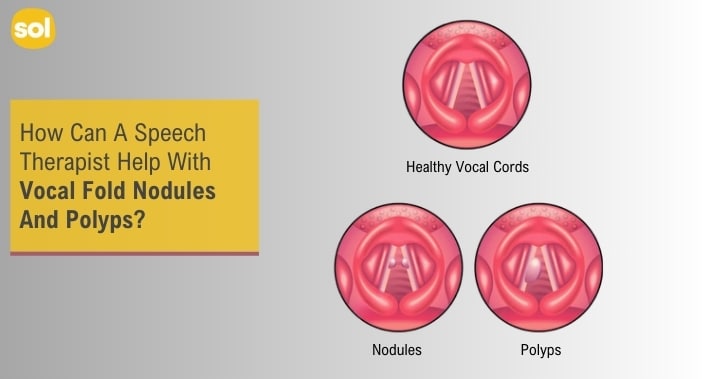
Vocal fold nodules are growths that may form on one or both of your vocal folds.
These growths are benign, meaning that they aren’t cancerous.
RELATED ARTICLE: How Can Speech Therapy Help With Laryngeal Cancer?
Vocal fold nodules can form due to overusing your voice, or using it in the wrong way, which can lead to swelling.
Over time, these swollen spots, which typically develop in the middle of your vocal folds, can harden and become callused.
If your voice continues to be overly strained or misused, these nodules can become even larger and harder, leading to voice production issues.
How To Tell If You Have Vocal Fold Nodules
Vocal fold nodules can make it harder for your vocal folds to vibrate, leading to voice problems.
Some common signs and symptoms of vocal fold nodules can include:
- A harsh sounding voice
- Breathiness
- A rough voice
- A scratchy voice
- Shooting pain from ear to ear
- Neck pain
- Vocal and body fatigue
- Diminished ability to change your pitch
- Hoarseness
- Feeling like you have a lump or bump in your throat
If you have vocal fold nodules you may experience just a few or most of these symptoms, depending on the size of the growth and to what extent it interferes with your vocal fold movement.
What Are Vocal Fold Polyps?
Similar to vocal fold nodules, vocal fold polyps are swollen bumps or growths that can occur on your vocal folds due to misusing or overusing your voice.
However, as a result of rubbing, having a vocal fold polyp on one of your vocal folds can lead to the formation of an additional polyp on your other vocal fold.
While vocal fold polyps may vary in size, they’re usually larger than vocal fold nodules.
They may appear like a swollen spot or bump, but may also appear as a blister or an elongated growth.
Vocal fold polyps can form after a single episode of misusing your voice, such as yelling.
How To Tell If You Have Vocal Fold Polyps
The signs and symptoms of vocal fold polyps are similar to vocal fold nodules.
Both cause swelling or growths on your vocal folds that can interfere with how your vocal folds open, close, and vibrate, which can lead to voice production issues.
The most common symptom is hoarseness or a raspy voice.
In addition to the symptoms we listed in the previous section, other symptoms of vocal fold polyps or nodules may also include:
- Loss of voice
- Breaking your voice easily
- Frequently coughing or needing to clear your throat
- Loss of vocal range
Why Do People Get Vocal Fold Polyps And Nodules?
Vocal fold nodules are typically caused by long term overuse of your voice.
Anyone can get them, but they are more common in people who use their voice excessively, such as:
- Children
- Teachers
- Trainers
- Coaches
- Singers
- Professional speakers
Vocal fold polyps can also be caused by long term vocal abuse, but they can also be caused by one vocal abuse episode, such as yelling.
Being a long term smoker, having thyroid problems, or GERD can also cause vocal fold polyps.
There are many different ways to misuse or overuse your voice, which can lead to the development of vocal fold polyps and nodules.
Some of the things that can result in vocal abuse may include:
- Smoking
- Allergies
- Speaking loudly
- Consuming alcohol and caffeine
- Singing
- Coaching or teaching
- Having tense muscles

How Can Speech Therapy Help?
Speech therapy can help you take care of your voice to address and decrease the effects that vocal fold nodules and polyps may have on your voice.
A speech therapist can help you learn how to take care of your voice through implementing vocal hygiene techniques.
They can help identify and address the root cause of your vocal abuse, which may be caused by unhealthy vocal hygiene practices.
Unhealthy vocal hygiene practices can include:
- Speaking loudly
- Shouting
- Coughing
- Clearing your throat
- Poor hydration
Treatments may also be geared towards helping you change the sound of your voice.
This can include breathing techniques to help your articulation, as well as relaxation methods to promote proper vocal fold movement.
Other ways speech therapy can help with voice issues caused by vocal fold polyps and nodules can include:
- Focusing on your vocal strengths and weaknesses
- Improving self awareness of muscle tension
- Teaching you communication skills and strategies
- Addressing factors that contribute to poor vocal hygiene
- Helping you establish appropriate vocal hygiene practices
- Providing training and accommodation for alternative communication methods
Regardless of the underlying cause, speech therapy can help provide treatment for vocal fold nodules and polyps to help you communicate better and free your voice.
Book Your Appointment With Our Speech Therapy Clinic Today
Are you or your child having speech related issues because of vocal fold nodules or polyps?
Don’t worry, our therapy team can help.
At both our clinic locations in Austin and Round Rock, Texas, we offer speech therapy solutions to address any issues that may be impacting your ability to communicate effectively.
Book your appointment with Sol Speech And Language Therapy today, to get started.
1812 Centre Creek Dr. Suite 121,
Austin, TX 78754
(512) 368-9488
Sol Speech & Language Therapy offers personalized skilled intervention to those struggling with their speech and language skills. Services offered include screening, consultation, and comprehensive evaluation. We also provide one-on-one and/or group therapy for speech sound disorders, receptive/expressive language delay/disorder, stuttering/cluttering, accent reduction, and much more.